
Turns out You Kan
Reflections on a new book deconstructing House of Lies totem Immanuel Kant

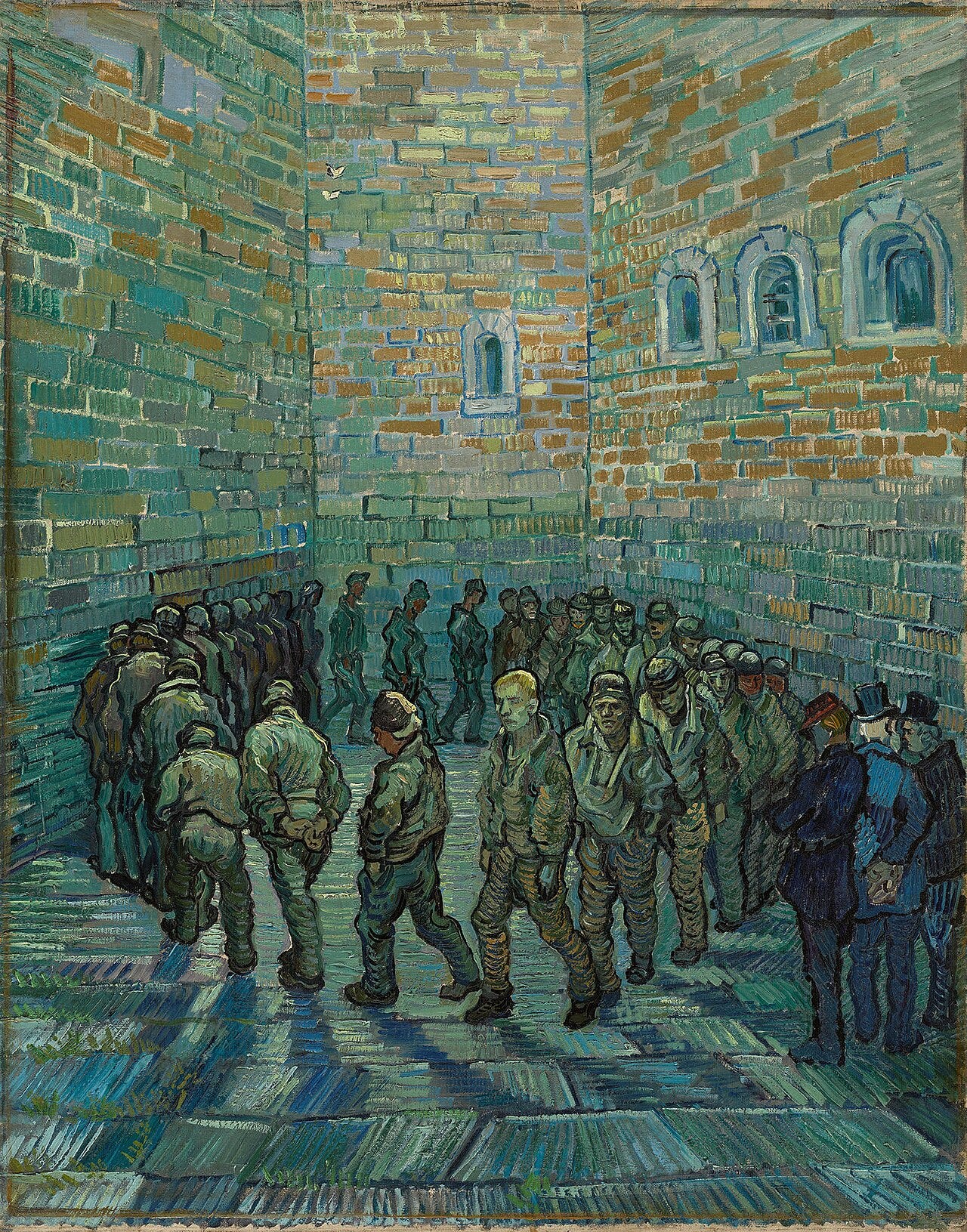
Vincent Van Gogh, Prisoners’ Round (after Gustave Doré), 1890, oil on canvas, Pushkin Museum, Moscow
A few months ago, a highly original book on Kant appeared. The description isn’t offered lightly. What makes Vox Day’s take different is the position it takes. None of the usual academic discursive game of reinterpreting, elaborating, applying, or otherwise paying homage to an idol of midwits. Instead, a deconstruction. Not in the pure Derridean sense of showing something presented as primary is actually dependent on what it claims to ground. But close enough, in that it turns the First Critique’s own claims against it. What makes deconstruction such a powerful critical method is the use of an author’s own words and claims. Close reading, not marshalling external arguments that can be refuted or obfuscated.

Click the picture for the link. There will be a few posts on this topic, so interested readers will want their own copy to follow along. The tl,dr is that it’s really good and worth reading whether you care about these posts or not.
The idea was to read the book, take some notes, and post a review-response. The first steps were done a while ago, but things got in the way before the posting. Also, it turned out there is a lot to say. So the plan now is a few linked posts that can be rotated into the regular recurring themes here. Especially since any Scriptposting can be folded into the usual House of Lies analyses as one factional wing. Why not fill some space with reflections on the Kant book. In particular, how it fits with the ideas in The Ontological Hierarchy that readers are used to.
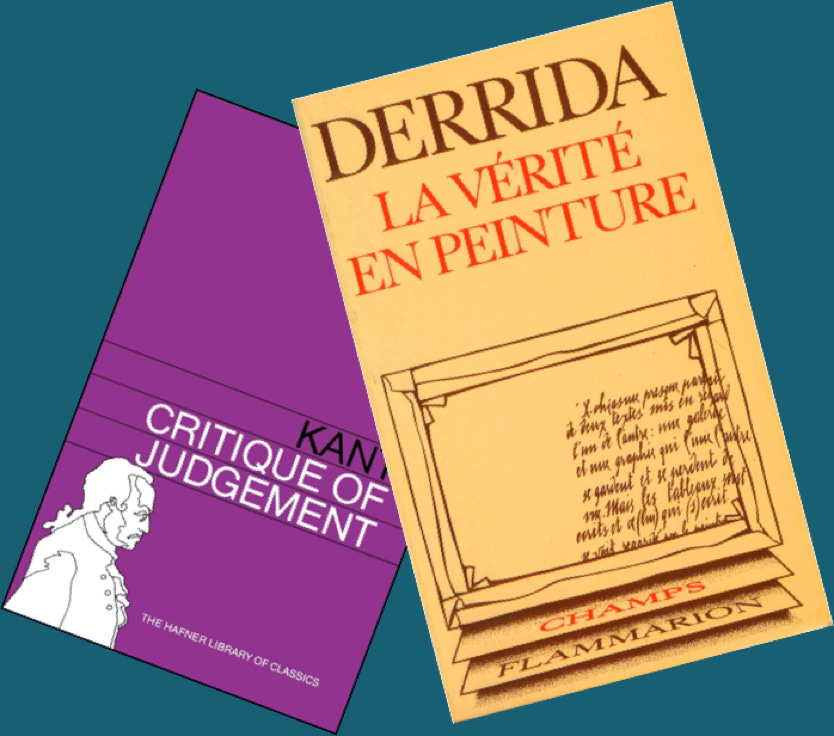
Derrida might be more torturous than Kant, which may be why his total implosion of “Kantian aesthetics” didn’t dustbin that nonsense for good. That and the weird cultic Kant worship that will come up later. Positions that aren’t really logical can’t be dispelled logically.
Start with an introduction, since that’s all I’ll manage today. I’m not a Kantian by any stretch. I’ve read his major works, including the three Critiques, as an autodidact, but that hardly = expertise. Especially given how dense he is. The only one I’ve really engaged with critically is the Third Critique, and Derrida blew that away so hard that I never had to. That was a classic deconstruction showing something presented as primary was actually dependant on something presented as secondary. In this case, Kant’s fantasy of pure autonomous object of indifferent contemplation being impossible without a defining frame. Really the opposite of pure autonomy.
So I won’t take up Day’s book from a position inside “Kant studies”. Which wouldn't be useful anyhow. Readers likely want discussion of the logic and arguments and how they relate to what we are doing here.

The book is very clear and lucid overall, especially given the subject matter. This is not usually the case, and that’s before getting into the performative convolutions that are often poorly substituted for quality thought. The structure reflects the productive form of AI co-authorship. I don’t see the synesthetic footprints of my own AI collaboration described in a recent post. But Day has clearly worked out his own constinctive force multiplying relationship.1 Something the AI paper explains will be highly personalized. And something I’d be interested in knowing more about, given that paper.

Philosophically inclined readers know The Ontological Hierarchy rejects Kantian - or Enlightenment - onto-epistemology all together.2 The term “noumenal” turns up in reference to the ultimate grounding of reason and observation that necessarily exceeds infocognitive apprehension. But this doesn’t → unknowable or unreal. The conclusion is the need for faith as a third epistemological mode. Something Kant ironically exhibits when he presumes a cognitively stable ontology. The OH offers a constinctive model of grounded ontological distinctions that are knowable in different ways. Which is not a contradiction of Day’s claim of Kantian supremacy in modern thought, but a confirmation. The OH lands outside any mainstream discourse and had to be self-published as a result.
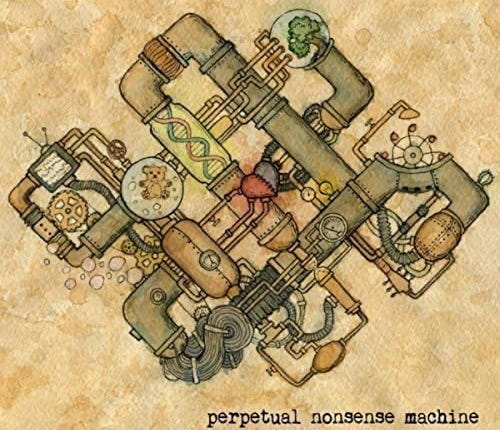
What the OH does not do is look at the internal mechanisms of post-Enlightenment thought. It sidesteps spurious arguments for inductive reasoning from basic axioms. While accepting the representational nature of our understanding. There is nothing in it like the focused deconstruction of a discursive tentpole although the conclusions are fundamentally complementary.

Productive deconstruction has a purpose, not just unravelling for its own sake. The purpose here is made by the cover image. The book lays out how core ideas in Kant formed the self-aggrandizing, self-righteous, and pernicious false foundation of Enlightenment epistemology. With horrible practical consequences for our understanding of reality. The fullness of what we can know and how we can know it locked in a Kantian box. With the deconstruction offering a path back to nothing short of a more honest and complete relationship with reality.
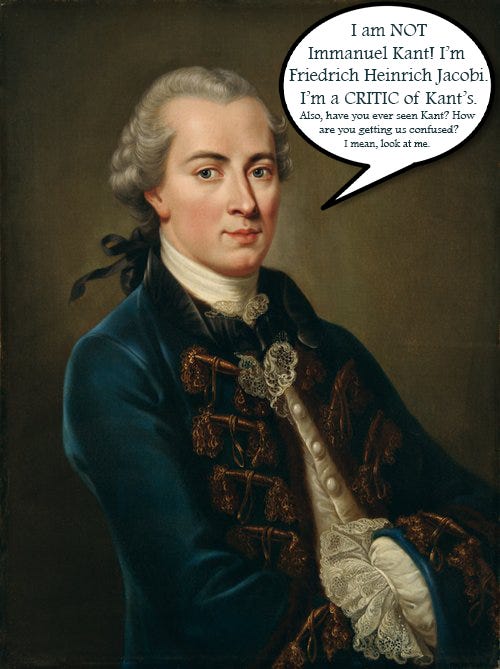
Karl Wingender after a lost original by Johann Christian von Mannlich, Portrait of Friedrich Heinrich Jacobi, around 1830, oil on canvas, Goethe House
Day positions himself carefully which is necessary for a subject as trodden and gatekept as Kant. I particularly like his use of “historical Kant” to differentiate the actual man and his writings from the absurd encrustation of addenda, interpretations, extrapolations, and other distortions that have proliferated in the modern academy.
The above portrait is often labeled Kant, but isn’t. Easy to see why…
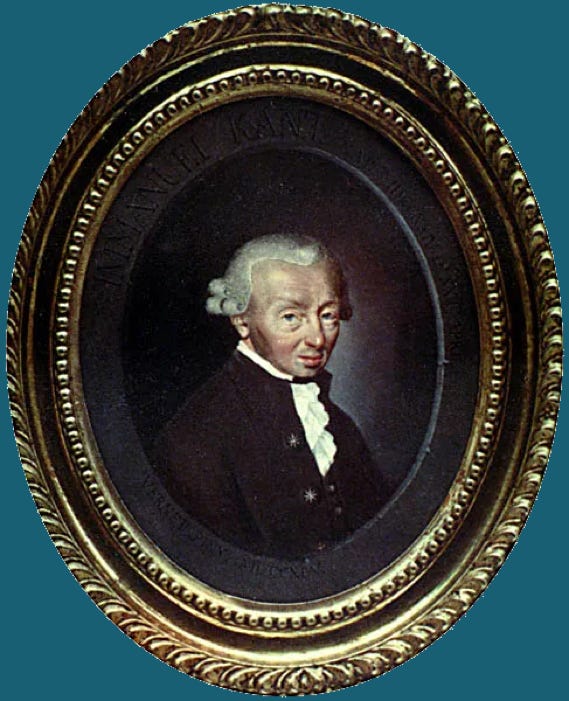
Carle Vernet, portrait of Kant, 1795, oil on canvas, Berlin, Kaiser Friedrich Museum
This is Historical Kant. He was quite the looker… There does seem to be a correlation between [weird little creep] and a certain kind of House of Lies appeal. Too much of a digression for now, but worth noting as a pattern.
The less cosmetic problem is that Discourse Kant has become such a bloated and formless blob that any objection can be handwaved away by citing things he didn’t actually write.
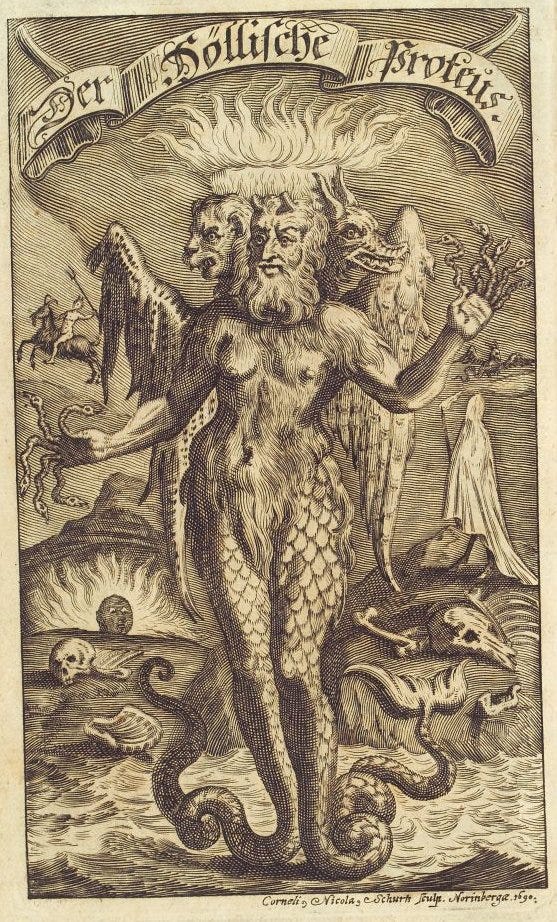
Cornelius Nicolaus Schurtz, from Erasmus Francisci’s Der Höllische Proteus (The Hellish Proteus), 1690, where the antique shape-shifting sea god is a metaphor for satanic deceptions. “The Hellish Proteus, or Thousand-artistic Adjuster, by means of the various image confusions of appearing ghosts, Throwers and polar spirits, ghostly signs of the death cases, as well as others aventerish trade, deceitful pranks, and strange ups of this damned actor, and, of partly scholars, for the human life spirit misreviewed traitors”, p. 409.

Day astutely points out that once something is protean enough to encompass anything, it becomes meaningless. It's simple cancelling out. If “Kant” is a category that is synonymous with everything, what’s the point of having it? Just drop it and use “everything”.
This raises a real question. What is the point of maintaining a totem that needs to be rewritten to hold up? Seriously. Why call yourself a Kantian while taking an original position that isn’t in Kant? It seems inane on the surface. The answer on the professional side is academic discourse. And that’s something for a future post. The deeper answer is a compulsion to maintain Enlightenment mythology even if the rationale is bogus. Better lies and auto-idolatry than truth and reality.

To say nothing of the comet tail of midwit fluffers who see him as the apotheosis of the Cartesian legacy. The intellect as autonomous sovereign subject because a dork in a room said so. It would seem odd that Science!-huffing progress types would worship a 17th century ignoramus like Descartes. But then we remember NPC theory, and that the one thing they know - cogito ergo sum - feels good. And not hard to read like Kant, whose worship is more like oracular mystery.
The appeal was historically irresistible to atavists attacking cultural authorities. Which, admittedly, were circling the bowl.

The hard to read shouldn’t be underestimated. It lets midwits posture over textbook summaries and experts spin pretty much whatever they want. This obviously shouldn’t be necessary. A legitimate authority stands or falls on his statements. And a legitimate follower of the thinker reads the thinker and judges the thought.
There’s an epicyclic pattern, like with collapsing materialist cosmology. Where instead of requiring the idea to be proven on merit, it’s accepted as some sort of writ because “not Christian”. Seriously, that’s where the commitment draws from. Then something equally unproven is made up to patch the leaks. Historical Kant focuses on the actual written text and scrapes the barnacles off the hulk. Like holding cosmology to what is empirically verifiable.
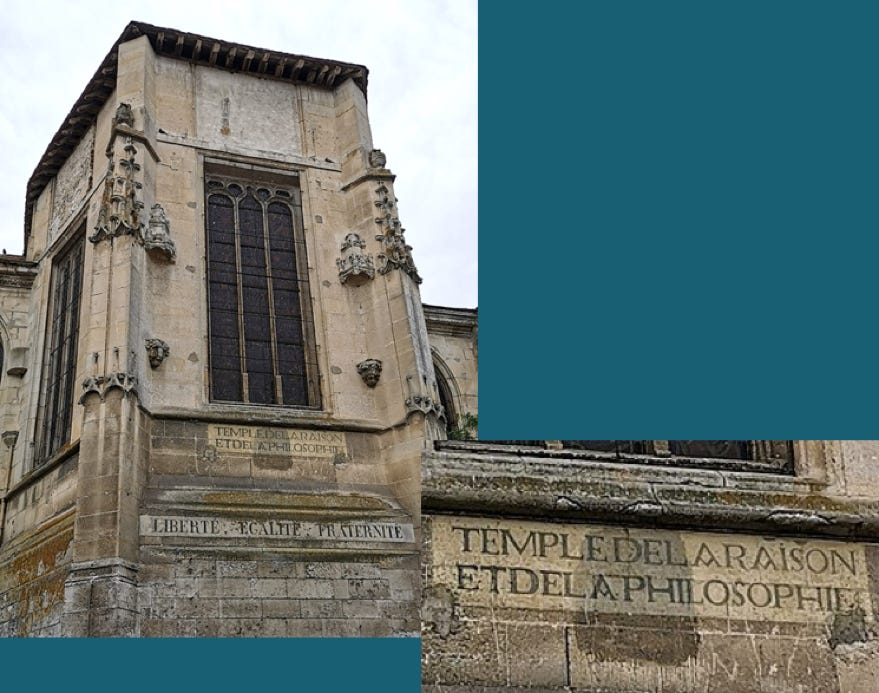
French Revolutionary inscription “Temple of Reason and Philosophy” on the Saint Martin church, Ivry-la-Bataille. First it was transformed into a place to worship “Reason” - the capital R makes it ok, then of the Supreme Being, whatever that is. Note to readers: regardless of your own beliefs, the [anything but Christianity] is ubiquitous when you watch for it.
Kantianism appears to be one of the secular transcendence category errors identified in The Ontological Hierarchy - faith where logic belongs. With an added beam of Gamma ray light.
In any case, Day is explicitly not referring to Discourse Kant, or Kantianism. That would be impossible, given the volume. This isn’t hyperbole. Here’s a simple demonstration. Harvard has the world’s biggest academic library and its catalog is freely accessible online. It doesn’t have everything, but it’s easy proxy. This is a one term subject search for “Kant” ordered by date.

How many of those 7,801 hits are even the experts reading? What about 633 dissertations? The thing to keep in mind is that this doesn't include individual articles. That would need a second search and I can’t be bothered. What this one does include are journals specifically dedicated to Kant. Reordered by relevance, these show on the first page alone:

The catalog has 15 journals specifically dedicated to Kant. This doesn't include the myriad philosophy and general arts journals where related articles appear. Of the five above, one is over a century old, but a couple launched in the teens. What possible value could these provide other than discourse inflation? But that’s for a future post.
This is running long, so wrap with the fundamental error that Day identifies. The fallacy is an amphibole - essentially a double entendre based on semantic uncertainty. Aristotle differentiates it from equivocation - amphibole is unambiguous in what it says, but ambiguous in how that is to be understood. I chased a man in my pyjamas for a simple example. Aristotle recommended avoiding this by thoroughly explaining the intended meaning where needed.
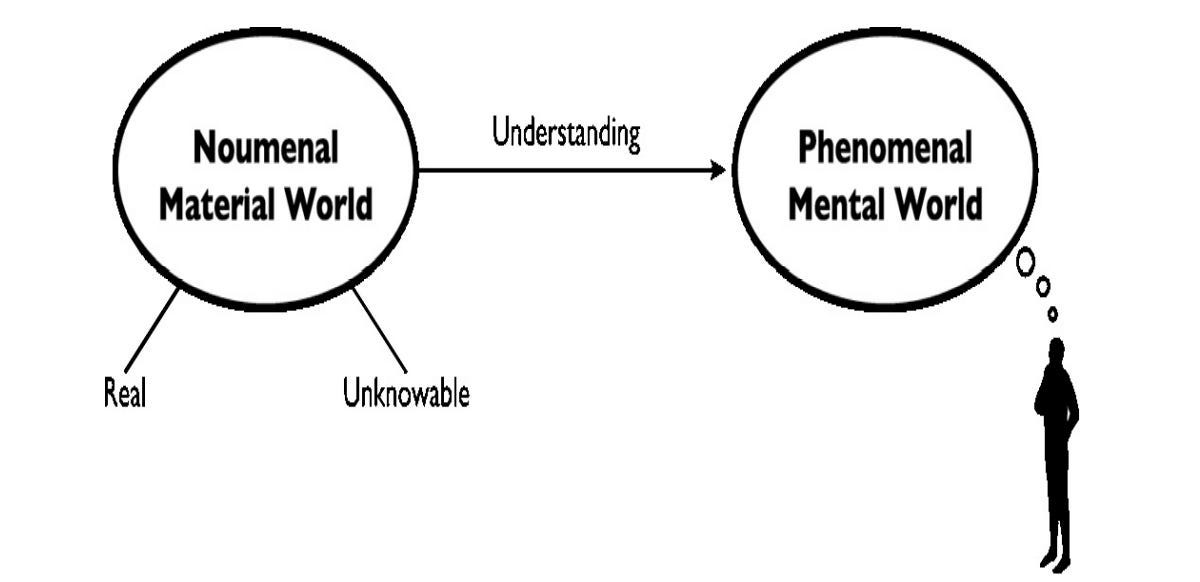
Kant does the opposite, presenting terms as having implications that they don’t.
The big one is that reality qua reality, the thing-in-itself, is unknowable.
The claim is hardly radical. We know the world through our sensory and cognitive processes. The Ontological Hierarchy calls it representational filtering. What we know is linked to how we know it. Then uses inductive logic to draw positive inferences about those aspects of reality that have to exist but lie outside our direct perception. We could call them known indirectly or imperfectly. Kant’s move is to declare partial or imperfect knowledge to be no knowledge at all. I can leave it to the reader to decide if imperfect = none at all. And if in doubt, Day makes the answer very clear.
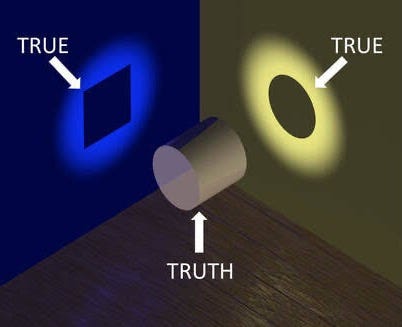
Perfective knowledge is “cylinder”. The square and the circle are imperfect apprehensions, both partially true. And, if someone took both of them, the cylinder could be inferred. Including its proportions. Kant’s whole cognitive structure of intuition and understanding is built off a Transcendental Aesthetic that presumes the complete unknowability of what he calls the noumenal. And of course there’s no adequate mechanism for how that noumenal comes into existence or grounds our shared perception of object permanence. Just the invocation of an unknowable, untestable realm that violates his own rules of logic.

Although he doesn’t go there, the postulation of a dogmatic unknowable fantasy behind a phenomenal world of appearances opens the door for a host of toxic nonsense. All the malevolent subjectivisms that decayed just about every socio-cultural index.
The next post will look at Day’s arguments more closely.
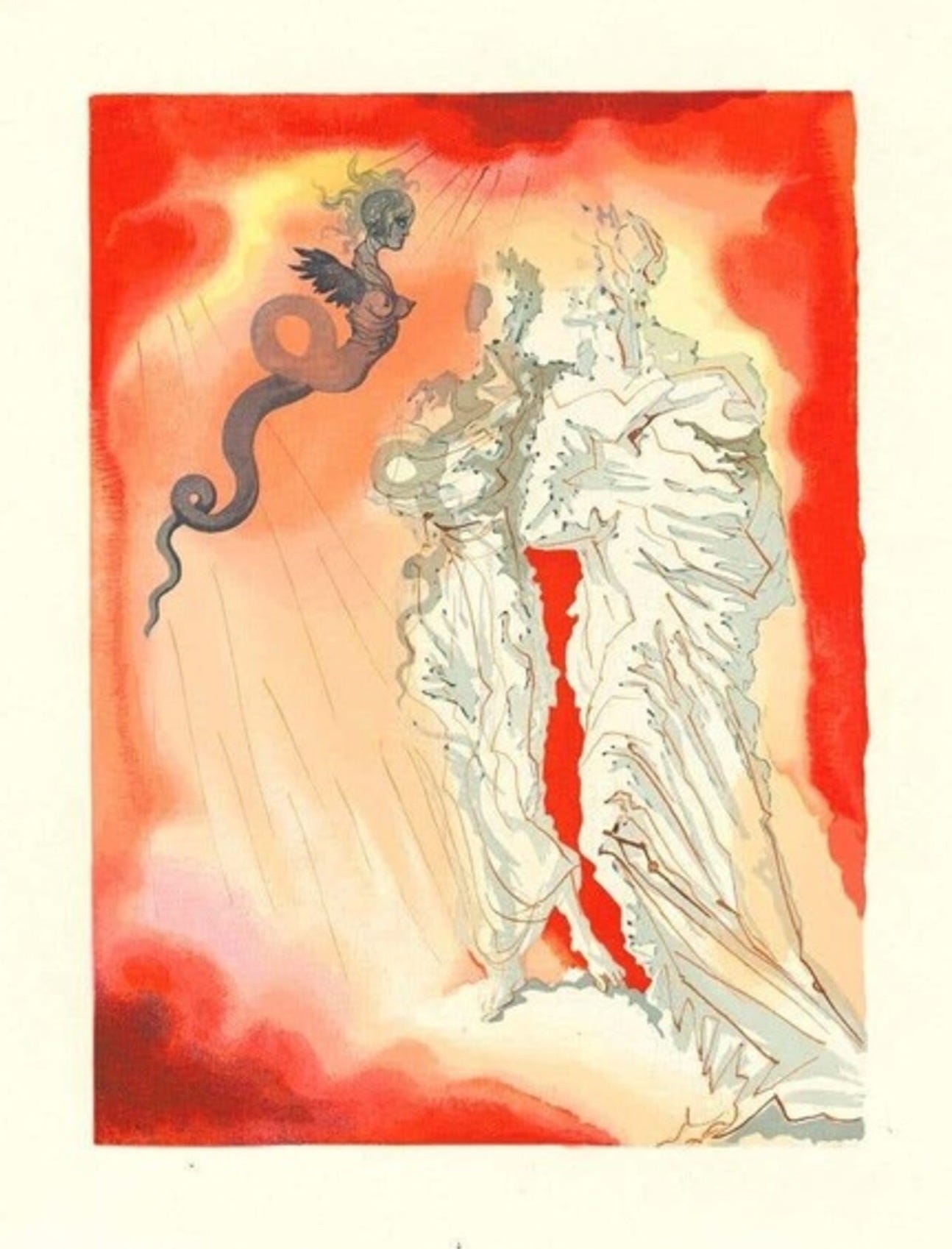
Salvador Dalí, Fraud (also known as "The Falsifiers" or Inferno Canto 29), 1963, woodcut on paper
Constinction is the term coined in The Ontological Hierarchy and used in the linked AI paper to refer to the hierarchical coexistence of continuity and difference.
Onto-epistemology is a philosophical term combining ontology - the structure of being - with epistemology - the structure of knowledge. Linking them acknowledges that our own cognitive and sensory capabilities impose conditions without denying that those offer conditional but meaningful knowledge of an external reality.
What a stupid conceit - imperfect knowledge is useless. Play a game of Spades all the way through and you'll realize just how far imperfect information can be used.
I was going to say "dismantling" might be a better word, since "deconstruction" is so tied to Derrida... then I find out Derrida did a deconstruction of Kant. Shows how much I know. But then, I never went to college so I never noticed this.
The portrait of Kant... good grief, if you drew a few shaky black lines over that face, it would be one of those internet meme faces.
Proteus and protean - I honestly don't think I ever realized until just now that the blobby shapeshifting character Proty from the Legion Of Super-Heroes likely derived its name from "Proteus" as much as "protoplasm." Good double meaning there, those Silver Age writers were sharp. I believe in this case it was SF writer Edmond Hamilton.
I'm not making a good case for my Noticing abilities here, am I?
"Midwit fluffers" is a perfect and brilliant term. Vox should do a song titled that.
"The intellect as autonomous sovereign subject because a dork in a room said so"... "instead of requiring the idea to be proven on merit, it’s accepted as some sort of writ because “not Christian”." - I'm not sure when I first realized these, but at some point I figured out that at least 80 to 90% of "philosophy" was exactly this. I'm not sure if I would have figured it out sooner or been further enstupidated if I had actually gone to college.
I actually consider myself fortunate that I wasn't able to go to college. Not only was I spared tons of bullshit indoctrination - like Kant - not to mention not racking up debt, but ended up on jobs and in places that taught me a lot of lessons that I probably would not have learned otherwise. Not to mention the physical labor of it kept me in shape for many years, and is probably still helping me somewhat.
Long comment, sorry.